How to Bill Hourly Not-to-Exceed Contracts
Without Gaming Your Own Time Records
When a client agrees to additional services on an hourly not-to-exceed basis, most A/E firms spend billing day doing math, figuring out how many hours they can bill at which rates to land exactly at the NTE cap. There's a better way. Bill every hour you worked. Let the system handle the cap. Here's how that works and why it matters.
The NTE Billing Problem Nobody Talks About
It happens on almost every additional services engagement billed on an hourly not-to-exceed basis. Billing day arrives. The project manager opens the time records and starts doing math.
How many hours can we bill at the principal rate? How many at the project manager rate? If we bill eight hours here and six there, does the total come in at or under the cap? The calculator comes out. Partial hours get entered. Hours that were actually worked disappear from the record. And somehow, month after month, project after project, the billing lands exactly at the NTE limit.
Funny how that works.
The instinct behind this behavior is understandable. The client agreed to a cap. The firm doesn't want to go over it and have an awkward conversation. Billing to the cap feels clean the invoice matches what was agreed, nobody has to explain anything, and the project moves on.
What gets lost in that calculation is the record.
Every hour the firm worked but didn't bill disappears. The documentation of what the additional services scope actually required. the real cost of the work, at real billing rates, for real hours, is gone. And when that scope expands further, when the NTE needs to be increased, when a change order conversation needs to happen, the firm has no documented basis for it. The time records say the work cost exactly the cap amount. The truth is the work cost more.
BaseBuilders handles NTE billing differently. Bill every hour you worked. The system evaluates the total billings to date for the NTE phase, and automatically adds a discount line to offset any amount above the cap. The invoice goes to the client showing the full hours at real rates and a discount that brings the total to the NTE limit.
No calculator. No partial hours. No disappeared records. And a complete documentation of what the work actually cost available when the conversation about adjusting the NTE needs to happen.
→ Read: Billing & Profitability for A/E Firms: The Complete Guide
When you manage your hours to hit the NTE cap exactly, you're not protecting the client relationship.
You're destroying the documentation you'd need to justify a change order conversation.
Bill what you worked. The record is what protects you later.
How NTE Additional Services Actually Work
Understanding why the billing problem exists, you first need to understand how NTE additional services typically arise, because the setup creates the pressure that leads to time record manipulation.
How the NTE additional service gets established
A project is underway under a fixed fee contract. A scope change arrives — the owner decides to add a building element, the program shifts, or a design condition emerges that wasn't anticipated. The change is real. It requires real work. The firm and client agree it constitutes additional services.
The client wants to authorize the additional work but is worried about open-ended hourly exposure. What if it takes twice as many hours as estimated? What if the costs run away? An open hourly arrangement feels like a blank check.
The firm proposes an hourly not-to-exceed amount. The client agrees. The scope is authorized. The work begins.
The billing pressure that follows
At the end of the billing period, the firm has logged real hours against the NTE additional services phase. In some months, those hours at the applicable billing rates produce a total below the NTE cap. No problem. In other months, the hours produce a total above the cap.
That's when the calculator comes out.
The project manager starts working backward from the cap: how do I get this invoice to the right number? Partial hours get billed. Some hours don't get billed at all. The billing rates get adjusted mentally to make the math work. The invoice goes out at exactly the cap, and the project moves on.
The problem is that this process is both time-consuming and destructive. Time-consuming because it requires manual calculation every billing cycle to figure out how much can be billed. Destructive because the hours that don't make it onto the invoice don't exist in the record, and those hours are exactly the documentation the firm would need to support a conversation about increasing the NTE when the scope continues to expand.
Why the documentation matters
The NTE amount was an estimate at the time it was agreed. Like most estimates, it may prove to be less than the work actually requires. When that happens, when the additional services scope is deeper than the original NTE anticipated, the firm needs to have a conversation with the client about authorizing additional hours.
That conversation is far easier with a complete time record showing exactly what the work required. "Here are the hours we logged, here are the billing rates, here is what the work actually cost, and we absorbed the difference against the original NTE. Now that we can see the full scope, we need to increase the authorization."
That conversation is far harder without the time record when the only documentation is a series of invoices that came in at exactly the cap every month, with no evidence of what the work actually required.
The NTE amount was an estimate. When the work costs more than the estimate, the firm needs a documented record to support an increase.
That record is the hours you worked — including the ones that went over the cap.
Billing them and discounting them back is not the same as not billing them at all.
The BaseBuilders Approach: Bill Everything, Discount Automatically
BaseBuilders handles NTE billing through an automatic discount mechanism that eliminates the calculator exercise and preserves the complete time record.
How it works
The project is set up with the NTE phase carrying the agreed cap amount. The team logs time against that phase throughout the billing period, at real billing rates, without managing hours to hit a target.
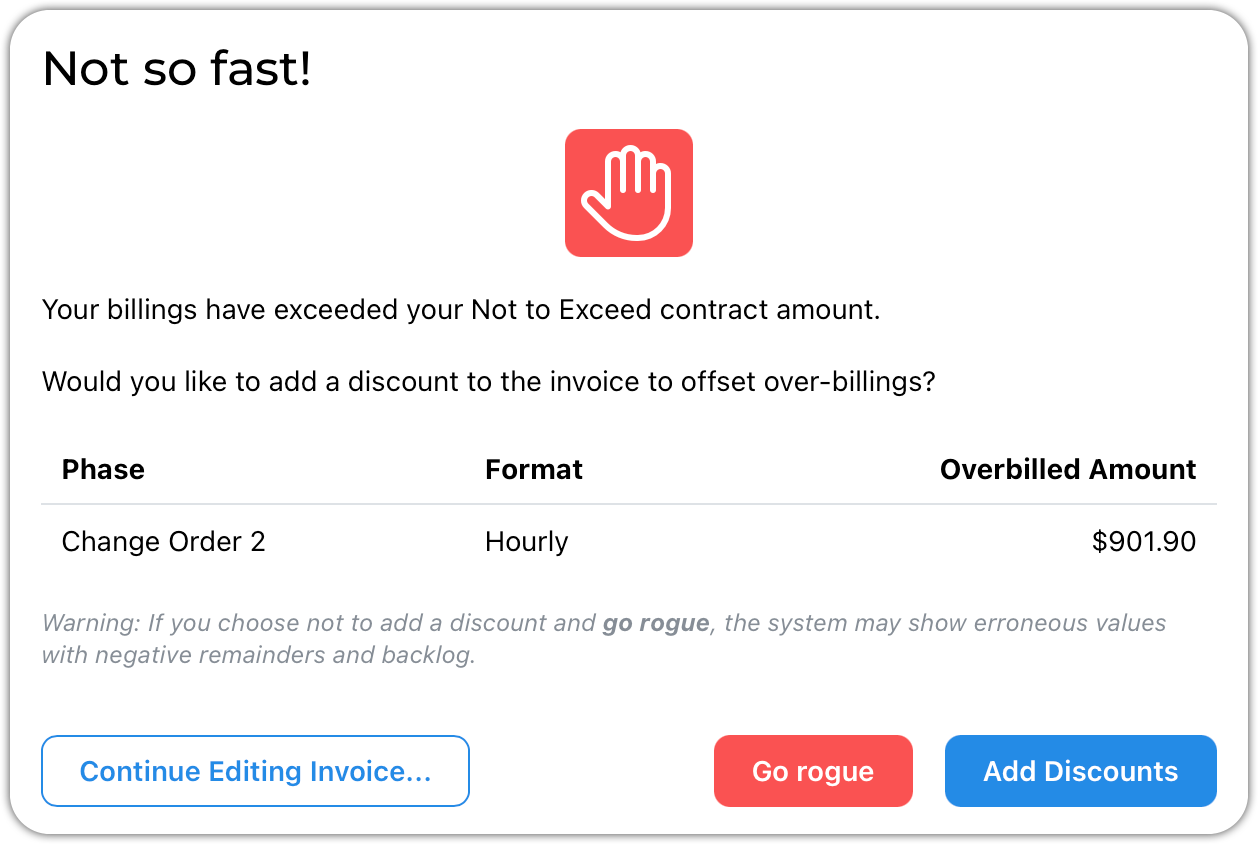
When the invoice is saved, BaseBuilders evaluates the total billings to date for the NTE phase. If the cumulative billing — the work invoiced in prior periods plus the current period — would exceed the NTE cap, the system automatically prompts the user to add a discount line to the invoice that offsets the overage.
The client receives an invoice showing:
- The actual hours worked, by team member, at actual billing rates.
- A discount line that brings the total back to the cap.
- A net invoice amount that matches the NTE limit
The client sees that the work required more hours than the current period's share of the cap. They see the discount applied. They understand that the firm is tracking carefully against the agreed limit and they have the information they need to make an informed decision about whether the NTE needs to be adjusted.
What it does for the firm
The firm never goes over the NTE cap without the client seeing it clearly documented. There is no embarrassing invoice that exceeds what was agreed the discount handles that automatically.
The complete time record is preserved. Every hour logged appears on the invoice. The discount is a billing adjustment, not a deletion. The hours are in the system, attached to the phase, available to reference when the NTE conversation needs to happen.
The billing process is faster. No calculator. No working backward from the cap to figure out how many hours at which rates add up to the right number. Bill what was worked, save the invoice, let the system handle the math.
The override: Go Rogue
When the invoice is saved and the NTE cap has been exceeded, BaseBuilders surfaces a dialog before the invoice goes out: "Not so fast!"
The dialog shows exactly which phase is overbilled, the contract format, and the dollar amount of the overage. The user has three choices:
Continue Editing Invoice - go back and make changes before the invoice is finalized.
Add Discounts - apply the automatic discount and send the invoice at the NTE cap. The complete hours remain in the record. The client sees the full billing and the offset. The system stays clean.
Go Rogue - send the invoice as-is, above the NTE cap, with no discount applied. The system warns that this will produce negative remainders and backlog figures because the contract cap has been formally exceeded. This is the right choice when the NTE is clearly exhausted and the firm needs to initiate a formal change order conversation rather than continue absorbing the overage quietly.
Going rogue is not a workaround. It is the moment the billing system signals that the additional services authorization needs to be revisited. The invoice goes to the client showing the full hours and the full amount. The cap has been exceeded, not hidden, not discounted away, but documented transparently. That invoice is the change order conversation.
The dialog makes the choice explicit every time the cap is approached. The firm cannot accidentally go over the NTE without seeing exactly how much and choosing deliberately what to do about it. That is the protection the system provides, not a guardrail that forces one outcome, but a stop sign that requires a conscious decision before the invoice leaves the building.
Bill what you worked. BaseBuilders makes sure you don't embarrass yourself by overbilling.
And when the time comes to have the NTE increase conversation, every hour you worked is in the record, ready to support the ask.
Why This Matters Beyond Any Single Invoice
The NTE billing mechanic is a small operational detail that has significant downstream consequences for firm financial management.
Realization rate accuracy
Realization rate, the percentage of billed work that becomes collected revenue, is one of the most important financial metrics in an A/E firm. When hours are routinely managed down to hit NTE caps, the realization rate calculation is distorted. The firm appears to be billing efficiently when, in fact, it is absorbing scope on every NTE phase; the absorbed hours simply never appear in the record.
A firm that bills all hours and applies automatic discounts has an accurate picture of what it is absorbing on NTE work. The discount lines are visible. The absorbed scope is quantifiable. The principal can evaluate whether NTE estimates are consistently too low, whether certain project types or client relationships generate more overage than others, and whether the fee structure for NTE additional services needs revisiting.
A firm that manages hours to hit the cap has none of that visibility. The absorption is invisible because the hours are invisible.
Change order support
Every NTE phase that runs over its cap is a potential change order conversation. The firm did more work than was authorized. The client may or may not know. Whether the firm recovers that value through an authorized NTE increase, a formal change order, or a negotiated adjustment depends almost entirely on the quality of the documentation.
An invoice history showing full hours with automatic discounts is strong documentation. It shows exactly when the NTE was approached, when it was reached, and how much work was delivered beyond the cap. The change order conversation starts from that record.
An invoice history showing billings that always land at exactly the cap is weak documentation. It supports the idea that the work cost exactly the NTE amountthe opposite of what the firm needs to argue when requesting an increase.
Client relationship quality
Paradoxically, the automatic discount approach tends to improve client relationships rather than create friction. Clients who see that the firm is billing all hours and that the firm's system applies a discount rather than hiding the overage develop confidence that the billing is honest. The firm is not managing the invoice to tell a story. It shows the work and applies the agreed cap.
When the firm eventually brings a change order request, the client has already seen the evidence building over multiple billing cycles. The request does not come as a surprise. It comes as a natural consequence of a billing history that was transparent throughout.
→ Read: What Are Additional Services in Architecture?
→ Read: Cash Flow & AR for A/E Firms
→ Read: Financial Metrics for A/E Firms
Cut Your Billing Time by 60% Within 90 Days — Or We Refund Every Penny
We're so confident BaseBuilders will transform your billing process that we're putting our money where our mouth is.

BaseBuilders’ easy-to-use software is specifically designed to help small to mid-sized firms track time, manage projects, stay on top of expenses, and more. We’ll handle the invoicing for you so you can focus on growing your firm and designing wonderful spaces.